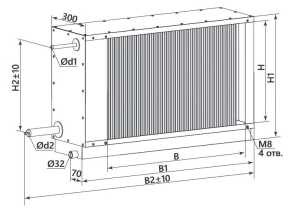
Freon coolers for ventilation are an excellent device for controlling indoor temperatures, which is appointed to work in conjunction with ventilation systems of various directions. They can also interact with supply and exhaust systems or improve the condensation process. The device passes normal or hot air through itself, cools it, and supplies it to the room.
The cooler housing is made of galvanized sheet with insulation against moisture condensation. The heat exchange surface is created by 0.1 mm thick aluminum plates stretched over 0.1 mm copper tubes.
Freon air coolers use refrigerants such as freon to remove heat from the air and cool rooms. Freon (chemically known as hydrofluorocarbons) is a type of refrigerant commonly used in air conditioners and refrigeration systems.
Freon air coolers operate on a cycle of compression and expansion of freon. The main components of the system include a compressor, condenser, expansion valve, and vapor evaporator. The process can be summarized as follows:
- Compression: freon, while in a vapor state, will be compressed by the compressor, which will increase the pressure and temperature.
- Condensation: high temperature and high pressure freon enters the condenser where heat is transferred to the surrounding air or water. This causes the freon to condense and become a liquid.
- Expansion: liquid freon enters through an expansion valve where the pressure and temperature drop sharply. This causes the freon to become a vapor.
- Evaporation: the vaporized freon passes through a vapor evaporator where it absorbs heat from the air circulating in the system. The freon is then returned to the compressor and the cycle repeats.
This process removes heat from the room and provides cool air. Freon air coolers are widely used for air conditioning in various premises, such as offices, residential buildings, shops, and others. It is important to consider the environmental aspect of using CFCs, as some of them can be potentially harmful to the ozone layer and climate.
The supply air for processing must not contain solid, fibrous, adhesive, or corrosive impurities that can corrode materials such as copper, aluminum, and zinc.
The construction of the cooler consists of a galvanized steel casing. Inside the case there is a freon heat exchanger, a drip trap and a drip pan. The latter is equipped with a condensate outlet for condensate drainage.

| Type measurement | Dimensions, mm | Weight in kg | |||||||
| В | В1 | В2 | Н | Н1 | Н2 | d1 | d2 | ||
| D-FOP-40/20 | 400 | 552 | 719 | 200 | 283 | 127 | 12 | 28 | 16 |
| D-FOP 50/25 | 500 | 652 | 819 | 250 | 333 | 177 | 18 | ||
| D-FOP-50/30 | 500 | 652 | 819 | 300 | 383 | 227 | 19 | ||
| D-FOP-60/30 | 600 | 752 | 919 | 300 | 433 | 227 | 21 | ||
| D-FOP-60/35 | 600 | 752 | 919 | 350 | 433 | 271 | 16 | 35 | 23 |
| D-FOP-70/40 | 700 | 852 | 1019 | 400 | 483 | 321 | 26 | ||
| D-FOP-80/50 | 800 | 952 | 1119 | 500 | 583 | 422 | 32 | ||
| D-FOP-90/50 | 900 | 1052 | 1219 | 500 | 583 | 422 | 36 | ||
| D-FOP-100/50 | 1000 | 1152 | 1319 | 500 | 583 | 422 | 42 | ||